CORP // 01
SAFETY
The law. Sentinels patrol. Auditors sentence. Tracers with blue light behind their eyes hunt the people who disappear from the grid.
There is no outside. There is only the Shelter, and their mercy.
That's what they tell you.
Two generations ago, the weather turned murderous. Acts of God—storms, fires, floods—strike without warning and rewrite the map. The corporations built Shelter 1 to keep humanity alive. Then they kept the keys.
The law. Sentinels patrol. Auditors sentence. Tracers with blue light behind their eyes hunt the people who disappear from the grid.
The old Internet is dead. Information controls what people know—and what the Roots are allowed to believe.
Food for everyone. Nanites in every bite: healing your body, tracking your movements, reporting your life.
Money and energy are the same thing: kinetic charge stored in sheathes. Every device runs on Joules. Every purchase spends them. And every Joule was charged by hand in Reform—the labor camps for those convicted under corporate law.
Somebody burned part of their life to power yours.
Dangerous country. Scattered communities. Travelers who leave and are never heard from again. Beyond that, the corporations offer no answers.
No one agrees where the map ends.
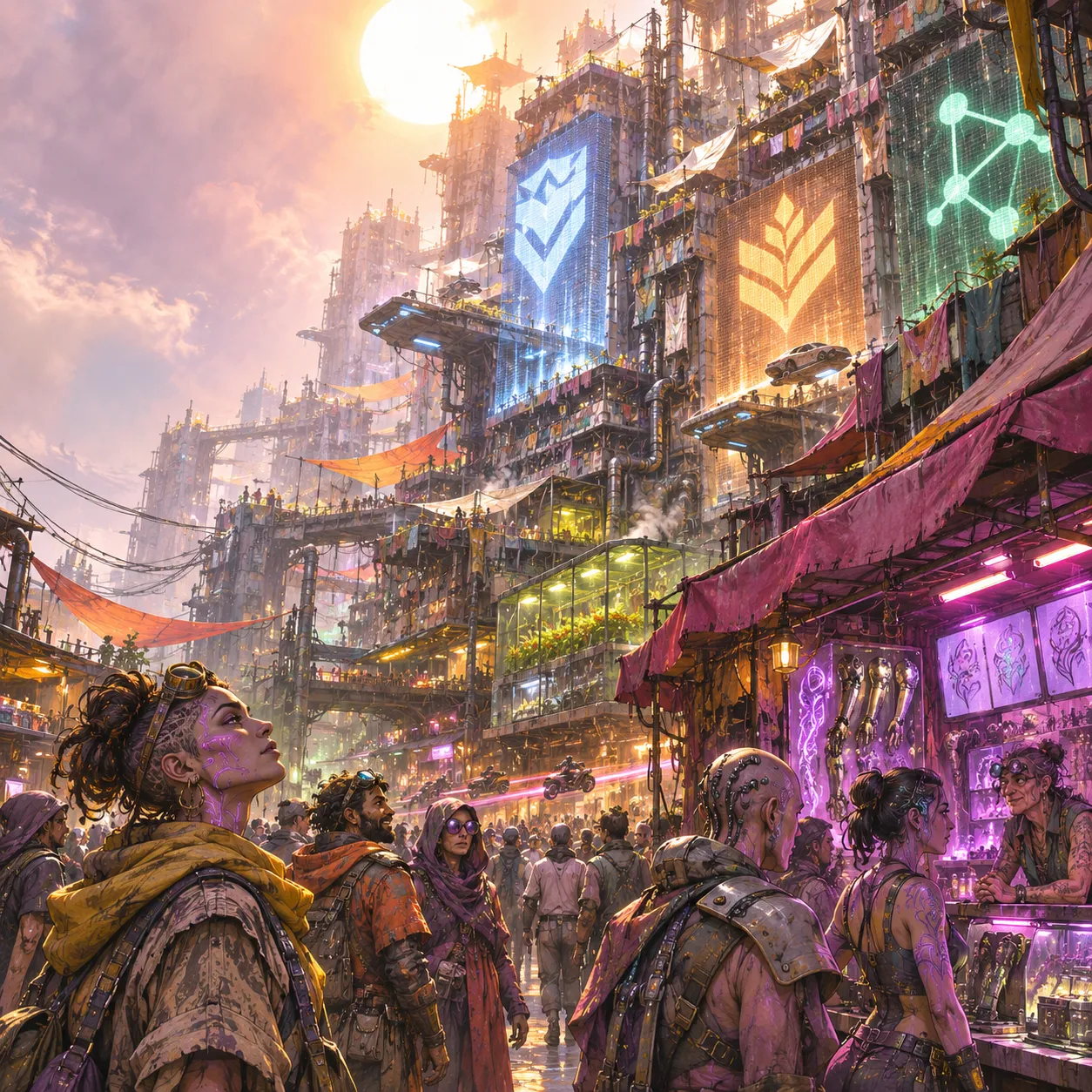
The vertical slums of the old Green Zone. Towers stacked with lives, markets, cables, smart-paper, and ads as tall as buildings.
The sun burns skin in minutes. Everyone takes Screen, a drug that leaves a faint purple tint. Spinners dock against towers. Cycles tear through the underlevels. Mod parlors sell GIF tattoos and cyberware behind projected corporate logos.
Status is inherited, enforced, and rarely fair.
You cut Nourish's nanite tether. The system can no longer see you. You wear an obscure over your eyes and live off the grid, where freedom and survival are rarely the same thing.
Maybe you steal. Maybe you sabotage. Maybe you pull someone else out before the Tracers find them. Whatever you do, the law will not protect you.
You play a Glitch: someone who broke free of the surveillance system that controls life in Shelter 1. You and your crew take dangerous jobs, steal from powerful people, make enemies, build relationships, and try to carve out a little freedom.
When an outcome is uncertain, you'll roll dice and find out what happens. Your characters are capable, but choices have consequences. You don't need to memorize rules or prepare a finished character sheet.
This is a story about what you want, what you're willing to risk, and who might pay the price.
You won't need to plan every detail in advance. The game can jump to the dangerous part of a job, and you'll discover what happens through your choices and the dice.
Faces from the Roots: people you might trust, people you might owe, and people you should avoid. These are glimpses of the world, not assigned characters. Your Glitch is yours to invent.
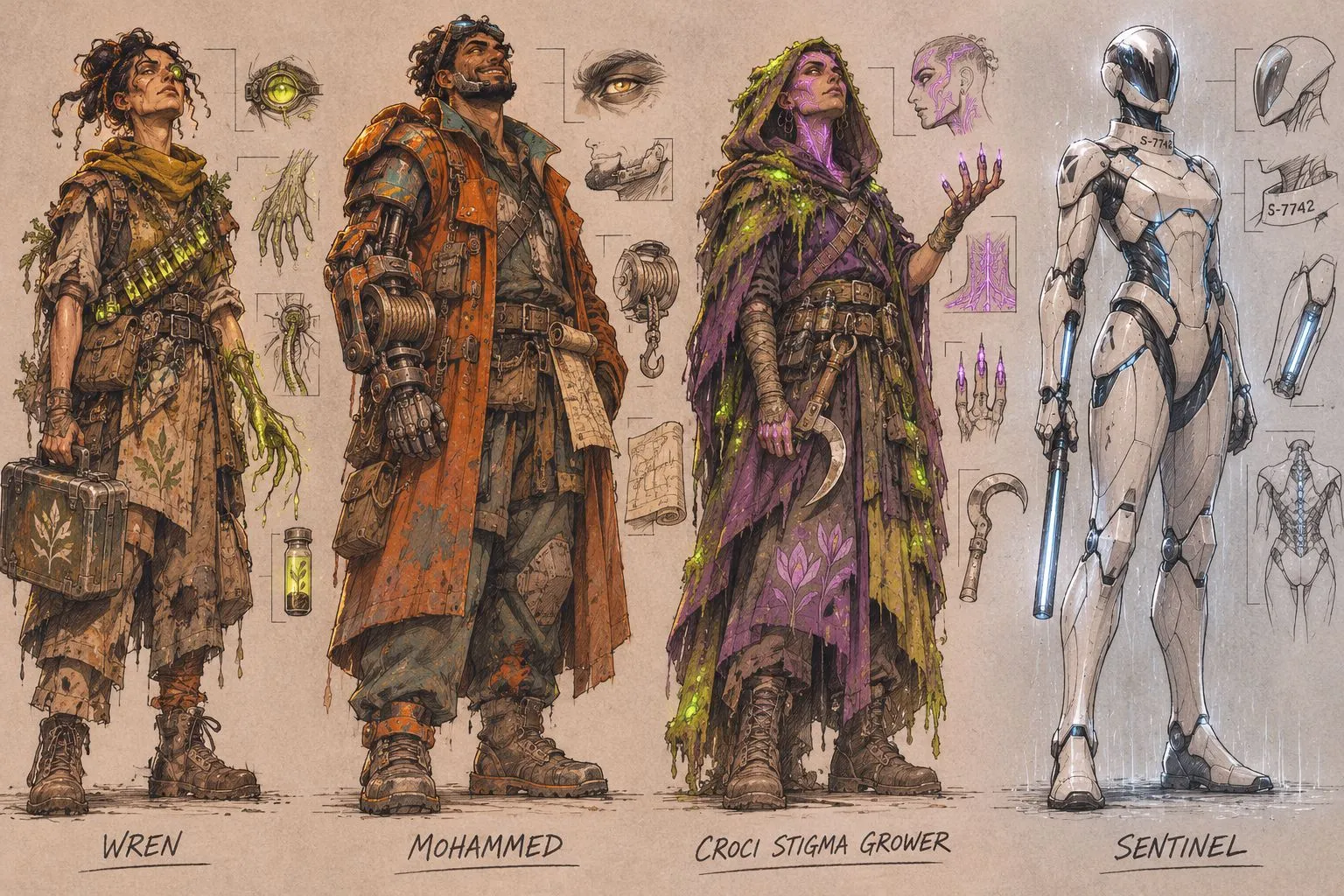
Wren, Mohammed, a croci stigma grower, and a Sentinel. Not everyone in the Shelter is on your side.
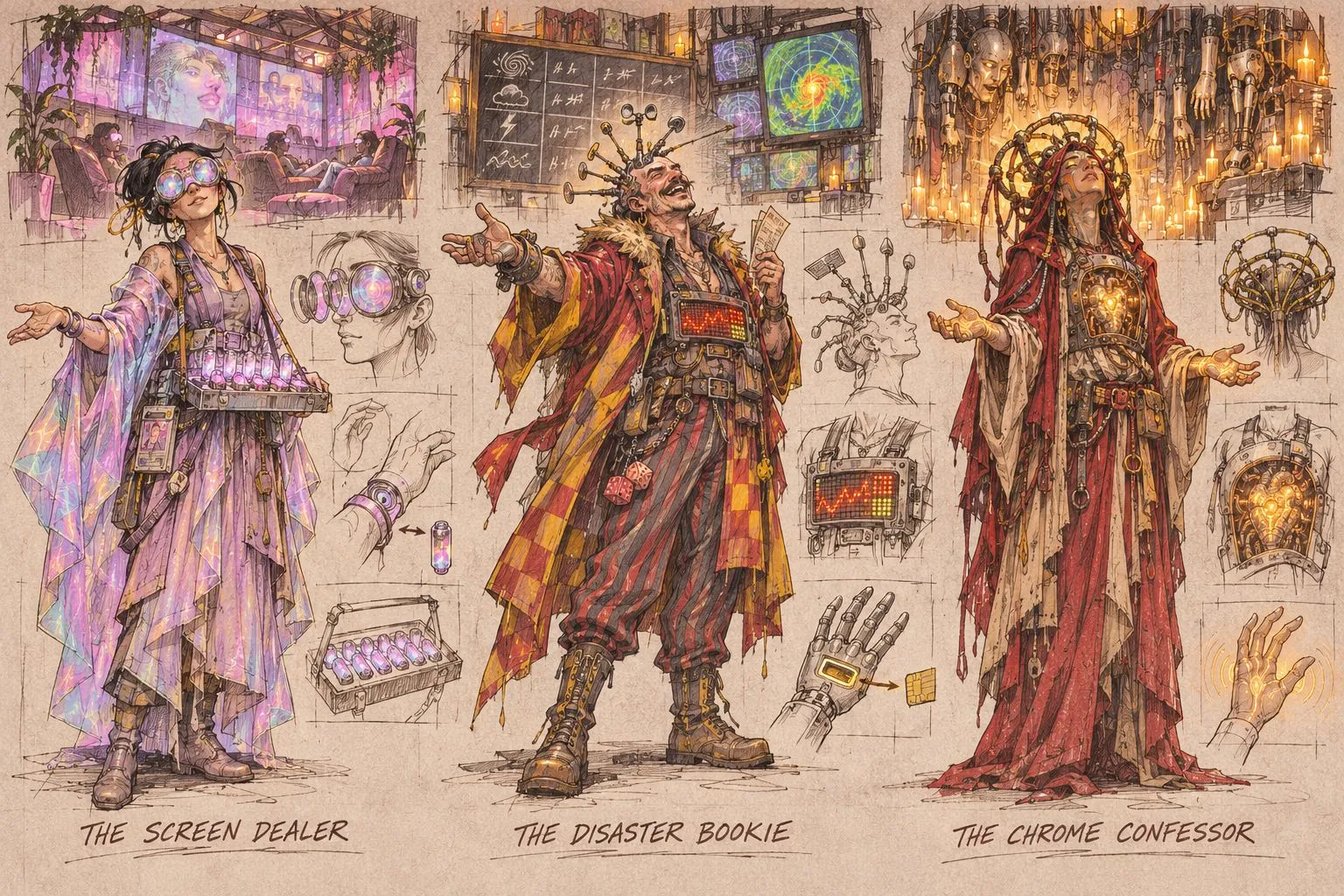
A Screen dealer, a disaster bookie, and a chrome confessor. Everyone has something to sell.
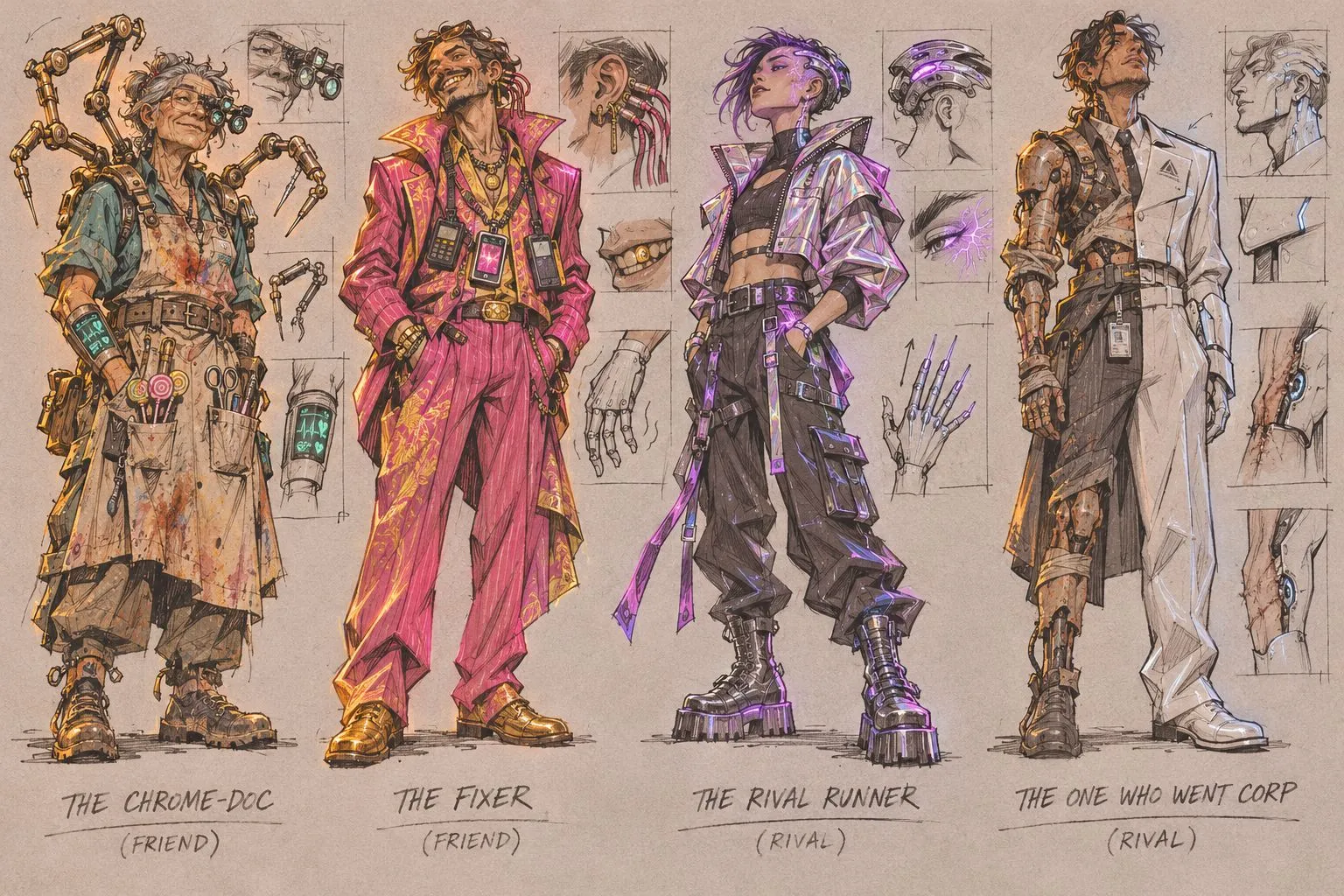
A chrome-doc, a fixer, a rival runner, and someone who went corporate. Your past is never fully off-grid.
A calling is your character’s specialty—not their whole personality. Pick the kind of trouble you’d enjoy getting into. These are story examples, not extra rules.
An enhanced fighter who meets force with force.
Sentinels close in. You hold the corridor long enough for the crew to escape.
What is the one line you refuse to cross?
XP THEME // Violence or coercion
ADVANCED CALLING — discuss with the GM before choosing.
Perfect and Gone alter the usual character rules; ask your GM before choosing either. You can change your mind at Session Zero.
A Glitch survives with a crew. Your crew's reputation tells the underworld what kinds of jobs you take—and the kind of trouble that follows you home. These are possibilities to imagine, not choices you need to make yet.
Mercenaries who make problems disappear: dangerous contracts, disappearances, and jobs nobody wants traced back to them.
Would you take a job without asking why?
Cycle-riding gangs who defend territory, shake down rivals, and hit hard before anyone can organize a response.
What corner of the city is worth fighting for?
Airship crews who descend on targets to steal, extract, sabotage, or uncover secrets before disappearing into the skyline.
What would you risk everything to snatch from the sky?
Vehicle crews who venture beyond Shelter 1, making deliveries, scouting unknown places, and chasing opportunities amid the Acts of God.
What could lure you beyond the walls?
Dealers in illicit goods, influence, and connections. They know how to find what people need—and what they'll pay to get it.
What can you get that nobody else can?
Which sounds like the most exciting kind of story? Bring a favorite or two to Session Zero. We'll choose a crew together, and every calling can contribute to more than one kind of crew.
You don't have to know everyone. These are the kinds of people a Glitch might turn to, run from, owe, or betray. Your own friends and rivals are yours to invent.
Chrome-Doc — patches wounds, repairs cyberware, and may ask for favors instead of Joules.
Fixer — connects crews to jobs, buyers, and people who need discretion.
Screen Dealer — supplies protection against the sun and hears street-level gossip.
Who helped you disappear—and what do you owe them?
Rival Runner — races you to a prize, a payout, or a reputation.
Old Associate — knows your secrets and now works for the corporations.
Disaster Bookie — wagers on dangerous events and remembers unpaid debts.
Who has a reason to come looking for you?
Safety Sentinel — enforces corporate law on the streets.
Auditor — decides punishments, often sending people to Reform.
Tracer — cybernetic hunter sent after Glitches.
Which part of the system knows your face?
Grower — tends crops or specialty plants under artificial light.
Chrome Confessor — hears secrets amid cyberware, belief, and desperation.
Neighbor — might hide you for a night, or report you for a few Joules.
Who would notice if you never came home?
These are evocative roles and possible connections, not fixed relationships or required NPCs. The concept-art plates above show some of the people who might inhabit this world.
The grid takes its toll. Every Glitch needs something to return to when the job is over. Your vice is the obsession, comfort, or compulsion that helps you survive the pressure—and can get you into trouble.
Stress is the pressure you carry. You can spend it to push yourself or resist consequences. During downtime, your vice helps you recover that stress—but overindulging can complicate your life. You do not have to portray anything that makes you uncomfortable.
Whisper prayers to a forgotten god, follow an ancestor’s rituals, or worship a mysterious signal.
Risk your Joules on illegal races, rigged games, or predictions of the next catastrophic storm.
Spend everything on rare fabrics, private climate control, or a single night pretending you belong in a corporate tower.
Care for your family, fund a neighborhood shelter, or give everything to a movement that needs you.
Lose yourself in food, art, intimacy, music, or a sensory experience you cannot find anywhere else.
Chase oblivion through intoxicants, brutal fighting pits, or any escape that shuts the world out.
Commune with rogue AI, experiment with forbidden technology, or study the patterns of the Acts of God.
What do you crave? Make the vice specific to your character.
Where do you go to get it? Imagine a person or place—your vice purveyor—that provides it.
What could go wrong? Who knows your weakness, and what might indulgence cost you?
During downtime, indulging your vice helps clear stress. But too much relief can mean trouble for you or your crew. You can invent your own vice or purveyor with the GM; the seven categories are starting points, not limits.
Based on Hack the Planet, character creation (p. 53) and Vice (p. 165). Perfect characters have a different vice procedure tied to serving a patron; discuss it with the GM if choosing that advanced calling.
Before session zero, bring the beginning of a person—not a finished character sheet. We'll build the crew together.
Alias, appearance, obscure, root, and the life you lived before disappearing.
What did the grid cost you, take from you, or nearly do to you? Why did you cut the tether?
Edge · Lens · Torque · Fuse · Haunt · Faint · Quirk. Advanced options: Perfect and Gone—ask the GM.
A signature item, an old friend, a rival, a debt. We'll settle action dots and crew mechanics at the table.
What helps you escape the stress? Who supplies it, and what trouble could it cause?
What would make you trust another Glitch with your life? What might you do to earn that trust?
What do you want badly enough to break the law for—and what might you become to get it?
We'll talk together about tone, boundaries, and which themes belong in our game. The setting can be harsh, but nobody needs to play out material they don't want at the table. We'll agree on how to flag and adjust uncomfortable scenes.
At the table we'll decide what kind of crew you are, how you met, where you hide, and what you're reaching for. You don't need to know any of those answers yet.
Bring a spark, not a completed character. Check off whatever you’ve thought about; the rest happens together at the table.
Nothing here is a commitment. We'll settle action dots, gear, contacts, crew type, and your shared history together.